
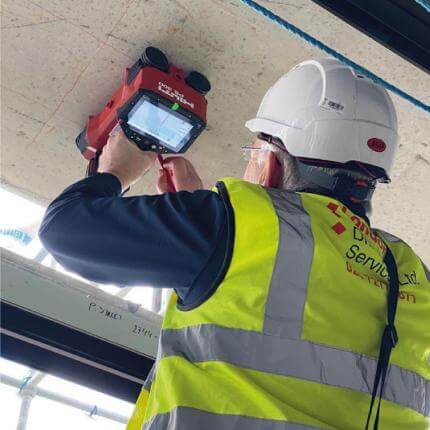
Rebar Scanning Survey in Greater Manchester
Enquire Today For A Free No Obligation Quote
At Rebar Scanning Survey in Greater Manchester, we specialise in the non-destructive investigation of reinforced concrete structures to locate and map embedded steel reinforcement bars.
Surveyors use advanced detection tools such as Ground-Penetrating Radar (GPR) and ferroscan devices to identify the position, depth, spacing, and diameter of rebar within slabs, columns, beams, and walls.
As rebar cannot be seen once concrete is poured, scanning provides essential data for structural assessments, safe drilling, core sampling, or refurbishment planning.
Since damage to structural steel during construction or alteration works can pose serious safety risks, a rebar scanning survey ensures precise targeting and compliance with structural integrity standards.
Request a free quote to learn more about our Rebar Scanning Survey in Greater Manchester expertise today.
What Is a Rebar Scanning Survey in Greater Manchester?
A rebar scanning survey in Greater Manchester is a specialist investigation that maps the location and characteristics of reinforcement within concrete without disturbing the structure.
Surveyors scan concrete surfaces using electromagnetic and radar-based instruments, capturing signals that reflect off steel components inside the concrete.
The output typically includes a 2D or 3D representation of the rebar layout, along with depth measurements, spacing calculations, and bar orientation.
Since many concrete structures in Greater Manchester include multiple reinforcement layers or congested areas, scanning is essential before carrying out penetrative works.
Why is a Rebar Scanning Survey in Greater Manchester Important?
A rebar scanning survey in Greater Manchester is important because it prevents accidental damage to reinforcement during drilling, coring, or structural alteration.
As cutting or striking rebar can weaken the structural load path, scanning protects both the building and its occupants.
Additionally, rebar surveys in Greater Manchester are often required for structural validation, post-construction QA, or to assess compliance with design drawings on refurbishment and retrofit projects.
What Does a Rebar Scanning Survey in Greater Manchester Include?
A rebar scanning survey in Greater Manchester includes the detection and mapping of reinforcement bars within concrete structures.
It records bar positions, depth, spacing, and diameter to give an accurate picture of reinforcement layouts.
A rebar scanning survey also identifies potential hazards such as post-tension cables or embedded services.
The survey provides detailed data that supports safe drilling, cutting, or structural analysis.
Since project in Greater Manchester needs vary, the survey scope can be adapted for structural engineers, MEP installers, demolition contractors, or asset managers.
What Equipment Is Used for Rebar Detection in Greater Manchester?
Surveyors use Ground-Penetrating Radar (GPR) and ferroscan devices in Greater Manchester to complete a rebar scanning survey in Greater Manchester.
GPR emits radar waves into the concrete, reflecting from metallic objects to create a depth profile. Ferroscan equipment uses electromagnetic induction to detect steel and measure bar diameters.
As each method has strengths and limitations depending on concrete type, reinforcement density, and site conditions in Greater Manchester, the choice of equipment is based on the specific survey environment.
How Accurate Is a Rebar Scanning Survey in Greater Manchester?
A rebar scanning survey in Greater Manchester typically achieves positional accuracy within ±5 mm to ±10 mm, depending on equipment resolution and surface conditions.
Depth accuracy for cover measurements is generally within ±2 mm to ±5 mm, and bar diameter estimations are suitable for identifying standard sizes.
As high-resolution scanning is sensitive to surface finish and embedded congestion in Greater Manchester, results are verified through multiple scans and quality-controlled before reporting.
How Much Does a Rebar Scanning Survey in Greater Manchester Cost?
The cost of rebar scanning surveys in Greater Manchester starts from £400 to £600 for small-scale, single-slab areas, and ranges up to £1,500–£3,000+ for larger or complex structures.
Factors affecting pricing include total scan area (in square metres), accessibility and working height, required reporting format (mark-up only, CAD overlay, or full report), and the number of areas or concrete elements to be scanned
Quotes in Greater Manchester are prepared based on site layout plans, access details, and any known construction drawings or reinforcement schedules.
Who Needs a Rebar Scanning Survey in Greater Manchester?
A rebar scanning survey in Greater Manchester is needed by contractors, engineers, and architects before drilling, cutting, or coring into concrete.
Facility managers and developers also use a rebar scanning survey in Greater Manchester to assess reinforcement layouts for maintenance, renovation, or structural upgrades.
Health and safety officers rely on rebar scanning surveys in Greater Manchester to reduce risks and ensure compliance with safety standards during construction activities.
Since hidden steelwork in Greater Manchester affects safety, liability, and construction sequencing, scanning is critical for both new-build and refurbishment projects.
What Are the Benefits of a Rebar Scanning Survey in Greater Manchester?
Rebar scanning in Greater Manchester protects your structure, team, and schedule by providing verified, non-invasive insight into reinforced concrete components.
The key benefits include:
- Avoids accidental damage to critical reinforcement during drilling or coring
- Confirms steel location and spacing for structural assessments
- Reduces health and safety risks during intrusive work
- Helps plan penetrations without compromising load paths
- Detects multiple layers of reinforcement and complex mesh arrangements
- Supports retrofit and refurbishment design by validating existing conditions
- Produces clear, actionable data with minimal disruption to operations
As structural integrity depends on the placement and condition of embedded steel, a rebar scanning survey offers valuable clarity before any intrusive work begins.
How Long Does a Rebar Scanning Survey Take?
Most rebar scanning surveys in Greater Manchester can be completed within half a day to two days on site, depending on the number and size of areas to be scanned.
Reports and drawings in Greater Manchester are typically issued within 2 to 5 working days following the site visit, with urgent turnaround available upon request.
Is the Survey Suitable for Live Sites?
Rebar scanning in Greater Manchester is a non-destructive and low-noise method, making it suitable for use in occupied buildings, commercial premises, or operational facilities.
As scanning requires no drilling, cutting, or coring, it can be conducted during working hours with minimal disruption to occupants or adjacent works.
Can a Rebar Scanning Survey in Greater Manchester Detect Multiple Layers of Reinforcement?
A rebar scanning survey in Greater Manchester can detect multiple layers of steel reinforcement within concrete elements.
As ground-penetrating radar (GPR) can detect variations in dielectric properties at different depths, the equipment identifies both upper and lower rebar layers in slabs or beams.
Since deeper layers produce weaker reflections, scan resolution and signal interpretation become especially important in complex or thick concrete structures in Greater Manchester.
Is Rebar Scanning Required Before Core Drilling or Saw Cutting?
Rebar scanning in Greater Manchester is strongly recommended before any core drilling or saw cutting in reinforced concrete.
Since embedded rebar is often positioned to carry load or prevent shear failure, damaging it during penetrations can compromise structural integrity and create safety hazards.
A rebar scanning survey in Greater Manchester identifies safe areas for coring while helping contractors avoid critical reinforcement zones.
Can You Estimate the Size or Diameter of Rebar?
Ferroscan equipment used during a rebar scanning survey in Greater Manchester can estimate the diameter of steel reinforcement within reasonable tolerances.
As the scanner measures the electromagnetic response of each bar, it can compare signal strength against known bar sizes to determine the likely diameter.
Since this method in Greater Manchester provides non-invasive estimation, it is useful for structural validation or checking conformance with original design specifications.
Is Rebar Scanning Affected by Surface Conditions?
Surface conditions in Greater Manchester such as rough concrete, paint, adhesive residues, or uneven coatings can affect the clarity and depth of readings in a rebar scanning survey.
As radar and electromagnetic signals depend on consistent contact and reflection, clean and smooth surfaces provide better scan quality and depth accuracy.
Site teams in Greater Manchester are often advised to lightly sand or clean scan areas prior to the survey for optimal results.
How Deep Can You Detect Rebar?
Rebar scanning in Greater Manchester typically detects reinforcement to a depth of up to 300 mm, depending on the concrete type, reinforcement density, and scanning equipment used.
As signal strength decreases with depth, rebar located beyond 250–300 mm may be difficult to detect clearly without enhanced GPR systems or exploratory exposure.
In thick slabs or walls, deeper scanning may still be possible, though with reduced resolution.
Can Rebar Scanning Be Used in Walls and Columns, Not Just Slabs?
A rebar scanning survey in Greater Manchester can be used to scan vertical and overhead concrete elements such as walls, columns, beams, and soffits.
Since these structural components also contain embedded reinforcement, scanning ensures that contractors avoid damaging bars during fixings, cut-outs, or embedded installations.
Specialised scanning tools in Greater Manchester are used for vertical and inverted surfaces to maintain accuracy and stability.
Does the Survey Produce a Physical Mark-Up on Site?
During a rebar scanning survey in Greater Manchester, detected reinforcement is often marked directly onto the concrete surface using temporary spray paint, chalk, or tape.
As this allows contractors in Greater Manchester to visualise safe zones and reinforcement locations in real time, the site mark-up supports immediate decision-making and on-site drilling.
Markings can also be photographed and included in the final report for reference and documentation.
Is Rebar Scanning Suitable for Post-Tensioned Concrete?
Rebar scanning in Greater Manchester can be used on post-tensioned (PT) slabs and beams, although additional care and interpretation are required.
As PT tendons are tensioned steel cables housed within ducts, they produce strong radar reflections that can be mistaken for rebar unless correctly identified.
Since damaging PT tendons during coring can lead to severe structural failure, scanning is essential before any intrusive work in Greater Manchester in post-tensioned concrete.
Do You Need Original Drawings for Rebar Scanning?
Original reinforcement drawings are not required to conduct a rebar scanning survey in Greater Manchester, although they are helpful.
As the scan detects the actual steel layout, it can be used to verify or supplement existing structural drawings and identify undocumented or altered reinforcement.
Where no drawings exist, scanning offers a reliable, non-invasive method to understand the internal structure in Greater Manchester.
Can You Scan Through Tiled or Carpeted Surfaces?
Scanning through thin surface finishes in Greater Manchester such as tiles, vinyl, or carpet is possible, provided the coverings do not contain metal or conductive materials.
As long as the surface is relatively flat and the scanner maintains good contact, the underlying rebar can be detected.
If thicker finishes or screeds are present in Greater Manchester, depth readings will account for the additional surface layer, and partial removal may be recommended for high-precision work.
Request a Free Quote for Rebar Assessments in Greater Manchester Today
A rebar scanning survey in Greater Manchester gives you the confidence to plan, drill, or assess reinforced concrete elements without risking structural damage or safety breaches.
Since the internal layout of rebar is not visible from the surface, scanning is a critical step for design validation, construction work, and ongoing asset maintenance.
Our surveys provide fast, clear, and accurate insights, whether you’re assessing compliance, installing services, or verifying structural capacity.
Get a free quote from Rebar Scanning Surveys in greater-manchester today, and ensure your next concrete penetration or structural decision is made with total visibility.
Find More Info
Make sure you contact us today for a number of great Rebar Scanning Survey services in North West.
Here are some towns we cover near Greater Manchester
Salford, Stretford, Eccles, Failsworth, DroylsdenFor more information on rebar scanning surveys in Greater Manchester , fill in the contact form below to receive a free quote today.
★★★★★
We contacted Rebar Scanning Survey before carrying out core drilling on a refurbishment project, and I couldn’t recommend them enough. Their team arrived promptly, worked efficiently, and provided precise data that saved us from costly mistakes. The report was clear and easy to interpret — excellent service all round.
Mark Ellison
Greater Manchester
★★★★★
Rebar Scanning Survey did an outstanding job on our commercial fit-out. The engineers were professional, thorough, and explained every step of the process. Their scan results gave our team complete confidence to proceed safely with drilling and alterations. I’ll definitely be using them again for future projects.
Sophie Turner
Greater Manchester